
transmission: what's fixing the grid? solutions + startups (part 3)
transmission! the middle child of the energy stack. part 3 in a series on transmission, bottlenecks, & solutions

In part 2, we covered the 7 biggest blockers in transmission: interconnection queues being chock-full, supply chain constraints, regulatory barriers, aging infra, cyber + physical attacks, and the challenge of integrating renewables.
In this third and final post, I’ll explore the innovations, tech, policy changes, and companies that are working to address these very hard problems and unblock the backbone of our energy system.
the solution space
The below solutions, and companies / organizations working on them, are organized around some of the highest-leverage points of intervention and innovation! These include:
establishing new lines
upgrading the grid
permitting reform + routing tech
advanced planning + forecasting
DERs + distributed solutions
storage + load matching
demand response + market reform
Let’s dive in!
establishing new lines
This seems like an obvious one, but it’s definitely far from the easiest solution (see part 2); it’s expensive, takes forever, and bogged down by regulatory complexity.
Specifically, what we need more of is high voltage direct current (HVDC) transmission - long, multi-state, and powerful.
Luckily, the DOE announced 10 potential ‘national interest’ transmission corridors where projects could be expedited1 totaling more than 3,500 miles across the Northwest, Mid-Atlantic, New York and New England, Southwest and Northern Plains. These are areas where a current lack of transmission capacity may drive up consumer electricity bills and where extreme weather can result in power disruptions.
In other countries like India,2 there has been some promising progress in the creation of “green corridors” which are, designed to connect renewable energy generation centers with high demand regions.
TransWest Express is building a HVDC and high-voltage alternating current (HVAC) interregional transmission system connecting four major balancing authorities in the Western Interconnection.
VEIR is a company that delivers 5-10x more power than conventional lines by establishing new lines.
Grid United also specializes in building long distance transmission lines.
upgrading the grid
While building new lines is slow, upgrading existing ones is often considered more viable, if not a bandaid solution.
Upgrades to existing transmission lines includes solutions that range from physical reinforcements via grid hardening to software systems to help with forecasting, planning, and monitoring.
Grid hardening is taking strategic actions to mitigate risks affecting grid resiliency, including storms and physical attacks. Hardening can occur through replacing poles, burying wires in the ground, elevating substations, and other tactics.
Reconductoring is the process of replacing existing wires’ infra with new, advanced conductors to increase their capacity and efficiency.
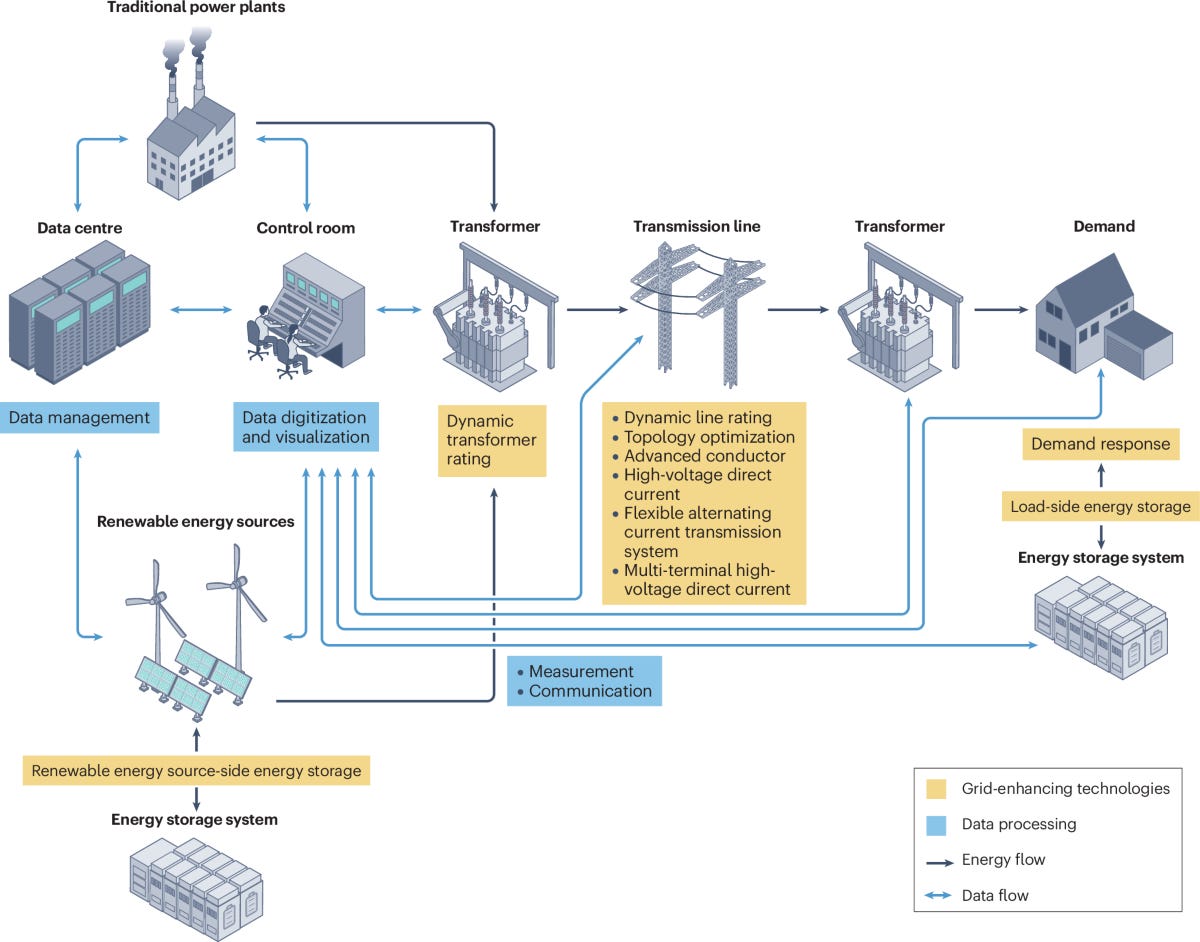
There are also many companies building grid-enhancing technologies (GETs). GETs can:
increase grid capacity and flexibility
allow for peak shifting and shaving
enable two-way communication between a utility + the end user
and encompass technologies such as:
dynamic line rating: monitoring the capacity of transmission lines in real-time and adjusting the line's carrying capacity based on factors like real-time temperature, wind speed, and sunlight
power flow control: the ability to redirect & manage the flow of electrical power within the grid system, primarily using power electronics devices
advanced grid monitoring & diagnostic systems: phasor measuring units (PMUs) are devices that measure the magnitude and phase angle of AC voltage or current at a specific location on a power line, providing synchronized data for wide-area monitoring of the electrical grid. These measurements are called synchrophasors which allow for real-time situational awareness of the grid's condition.
TS Conductor is an example of a prominent startup reconductoring existing lines with new conductors (AECC) that triple capacity without replacing towers.
LineVision is a startup working on building grid resilience including through GETs like dynamic line rating.
Tetra Tech is a company that offers cyber and grid hardening broadly.
The NCSL also finds that encouragingly, a few states have introduced and enacted legislation requiring utilities to consider GETs in their integrated resource plans as well.
permitting reform + rerouting tech
Reforms to planning and permitting for transmission is direly needed, as we discussed in part 2. Permitting remains one of the most stubborn chokepoints in the entire transmission process.
In fact, studies3 suggest that reforming the permitting process could unlock trillions of dollars in private investment, save consumers over $100 billion, and provide major emissions reductions by 2050.
Some companies are working on permitting reform:
TRC Companies specializes in routing, siting, and permitting services for transmission projects
Tetra Tech: Provides end-to-end permitting and environmental impact assessments for grid expansion
advanced planning + forecasting
Planning seems to be everything in this industry.
Advanced forecasting tools can help alleviate a lot of the complexity around planning for added transmission, and within the interconnection queue especially.
Forecasting tools in this space today utilize sophisticated algorithms and models to analyze historical data, weather patterns, and other factors to better predict future generation and load patterns. With such tools, grid operators can better anticipate the supply-demand dynamics and manage potential bottlenecks.4
GridUnity is a company that streamlines interconnection requests with automation of the planning and forecasting process for how projects will interact with the grid.
Tapestry is one of my favorite examples of moonshot companies leveraging AI for grid planning. Tapestry has proven efficacy in Chile, accelerating scenario simulations by 30x, and reducing approval time for renewables. This massively helps with grid transparency for regulators, and they’re in a partnership with PJM to help expedite interconnection delays there.
DERs + distributed solutions
One way to combat transmission delays is to circumvent them entirely. There has been a trend in the industry broadly towards meeting local demand with distributed energy resources (DERs) to alleviate strain on long transmission.
DERs are basically smaller-scale energy generation and storage devices that are located near the end user. Often they are still connected to the power grid, but in the case of microgrids, sometimes they are not. Being located near the end user means there is less of a requirement for long distance transmission. DERs are often solar panels, wind turbines, and battery storage, and are highly linked to the rise in renewables.
Note: storage and load-matching is a huge part of the DER equation and crucial for both enhancing grid resiliency (batteries can act as congestion relief) and making renewables possible at scale (battling intermittency). I’ll discuss storage and load matching in full in a dedicated post.
DER proliferation has been encouraged by policy, as recently a number of states have considered and passed legislation to incentivize DERs including through financing programs and tax credits.5
Many states have also enacted net metering policies to allow owners of DERs to sell the excess electricity generated, which has been a huge source of momentum for companies building in this space, including VC-backed Base Power, which installs batteries for energy backup in Texas.
demand response + market reform
Another way to reduce grid strain is less about supply and more about demand.
Energy is perhaps the only industry where supply and demand literally must always balance. It’s challenging, especially as intermittent energy sources like renewables come online.
Demand response is a strategy to manipulate energy demand. It is done through programs that encourage consumers to shift their electricity use away from peak hours (peak hours being in the evenings, when people get home, etc).
Tools like time-of-use pricing (prices being higher during peak hours when demand is high but lower during off-peak times), smart meters, and advanced metering infrastructure (AMI) allow utilities to send real-time price signals and usage data as part of this.
By charging EVs or running appliances during off-peak times, end users can lower their bills while helping the grid handle variability in supply. These programs are expanding, especially as market reforms increasingly allow demand response and energy storage to participate in wholesale electricity markets.
Voltus is a virtual power plant (VPP) operator that connects DERs to electricity markets and specializes in demand response. They help energy consumers reduce or shift their energy consumption in response to grid signals and pay them for these shifts.
Energyhub provides utilities with a platform to manage DERs like smart thermostats, electric vehicles, and energy storage systems, and also optimizes the grid through VPPs, like Voltus.
the highways of our electric future
Transmission is messy and difficult. It is the most overlooked, but arguably the most critical bottleneck right now in the clean energy transition. If we don’t act to untangle this mess, we might be shocked (pun intended, sorry) by electricity shortfall in the near future.
Fortunately, there’s been some promising innovation and regulatory developments, though there remains so much room for progress. In upcoming posts, I’ll explore the many more layers of the stack: interconnection, distribution, storage and load matching, and end use.
Thanks for reading!
https://www.utilitydive.com/news/doe-national-interest-transmission-nietc-ferc/715472/#:~:text=Delta%20Plains:%20A%20645%2Dmile,prevents%20delivery%20of%20affordable%20generation.
https://indiatransmission.org/green-energy-corridor#:~:text=The%20Green%20Energy%20Corridor%20Project,shown%20in%20the%20graph%20below.
https://www.vibrantcleanenergy.com/wp-content/uploads/2020/10/EIC-Transmission-Decarb.pdf
https://www.ncsl.org/energy/electric-transmission-interconnection-queues#:~:text=The%20combination%20of%20long%20timelines,grid%20regardless%20of%20wait%20times.